Why I Build Beyond the Ticket
How field work, full-stack engineering, and independent products shaped the way I think about complete systems—not isolated features.
- Journey
- Product Engineering
- Independent Work
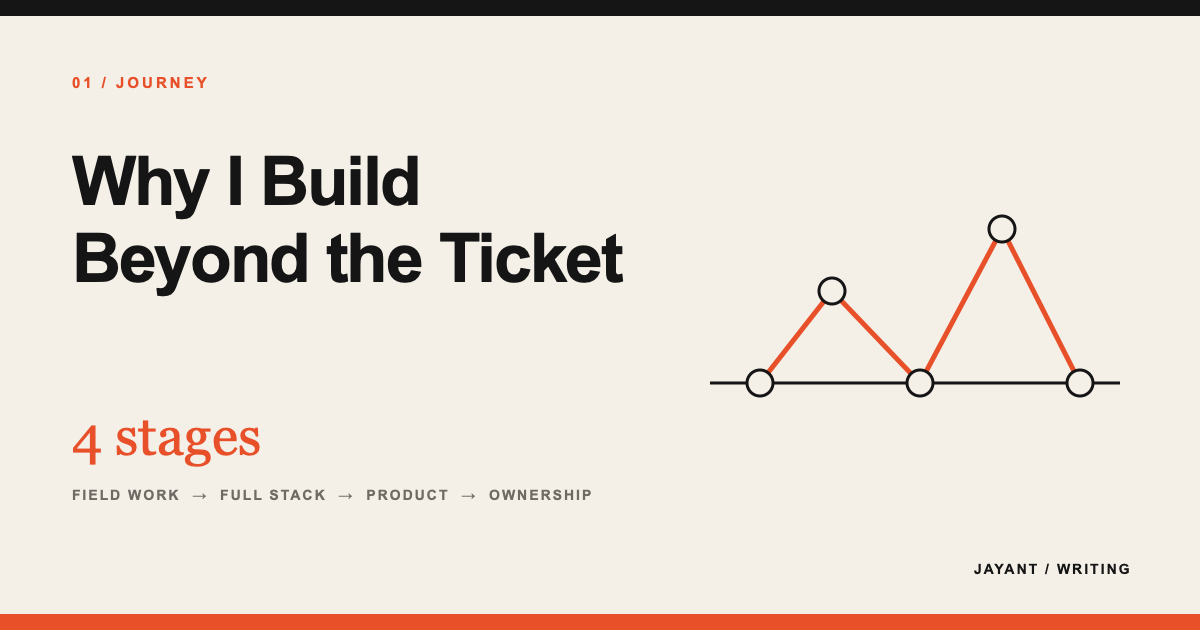
The first question I ask about a feature is no longer “How do I code this?” It is “What has to be true for this to work for a real person?”
That change sounds small. It has changed almost every decision I make—from how I shape an interface to where I put an authorization check, what I measure after release, and whether a feature belongs in the product at all.
This is the short version of how I got there.
The lesson arrived before the software
Before my first engineering role, I worked with a nonprofit team coordinating field campaigns and speaking with families directly. The work was not technical, but it exposed a product truth that technical teams can miss: the request described in a meeting is rarely the whole problem experienced by the person.
A form may collect every required field and still leave someone unsure about what happens next. A process may be correct on paper and still create avoidable effort. That gap between a delivered output and a useful outcome became the lens I later brought to software.
Full stack showed me the chain of consequences
In 2023, I joined HighRadius as a Software Development Intern. I worked across Java services, REST APIs, relational data, and React interfaces. That experience taught me to debug a feature as one connected path rather than treating frontend and backend work as separate assignments.
A button can depend on validation, authorization, a database constraint, a service response, and an operational decision the interface never reveals. A database choice that appears local can constrain every workflow added later. Once I could see that chain, “my part works” stopped feeling like a complete definition of done.
Product work changed what success meant
When I moved into a Product Associate Engineer role in 2025, the work came closer to operational outcomes. I began working on revenue-cycle-management workflows where automation, realtime information, and clear interfaces can reduce manual effort and prevent errors.
The useful questions became more concrete:
- Did the workflow remove a step or add one?
- Can the user understand the current state?
- What happens when a request partially fails?
- Is the audit trail strong enough to trust?
- Did the release improve the work, or only change the screen?
The framework still mattered, but only as a means to improve the workflow.
Independent building removed the handoffs
On December 7, 2025, I made the first commit to the platform behind this portfolio. I wanted a place where I could not hand an incomplete question to another team.
The public site had to explain the work. Studio had to turn experiments into usable products. Admin had to make content and operations manageable. Auth had to protect entry, recovery, MFA, and account security. One Supabase project had to support those products without blurring their data ownership.
Every missing decision came back to me:
| Layer | The question I had to answer |
|---|---|
| Product | Who is this for, and what should it help them finish? |
| Interface | What does the person need to understand right now? |
| Trust | Which input can be accepted, and which must be verified? |
| Data | Who owns the record, and what keeps that true? |
| Performance | What does the user actually wait for? |
| Operations | How will this be edited, deployed, observed, and changed? |
That is why the platform became more valuable to me than a collection of demos. It is a place to practice responsibility across the whole system.
The work became clearer when I started showing decisions
A screenshot proves that a page exists. It does not explain why the product is shaped that way.
The Work section of this portfolio shows the products. Writing shows the reasoning behind them: why I split one application into four product surfaces, how the CMS moves content from an authenticated editor to a public page, what actually reduced initial JavaScript, and why database-backed interactions felt slow even when page metrics looked healthy.
Each story follows the same standard:
- Name the problem in user terms.
- Show the system that produced it.
- Explain the decision and the rejected shortcut.
- Provide evidence where a measurable result exists.
- Be honest about the remaining tradeoff.
The principle I keep returning to
I like the whole problem, not only the screen.
That does not mean every project should become complicated. It means the simplest useful version must still respect the person, the data, the trust boundary, the failure mode, and the work required to keep it running.
That is the kind of engineer I am becoming: someone who can move from an ambiguous problem to a dependable product and explain the decisions in between.
See the products I have built, or continue with what product ownership looks like in practice.