What Product Ownership Looks Like in Practice
Six decisions that turn a feature into a dependable product: problem, trust, data, experience, failure handling, and operations.
- Product Ownership
- Full Stack
- System Design
- Delivery
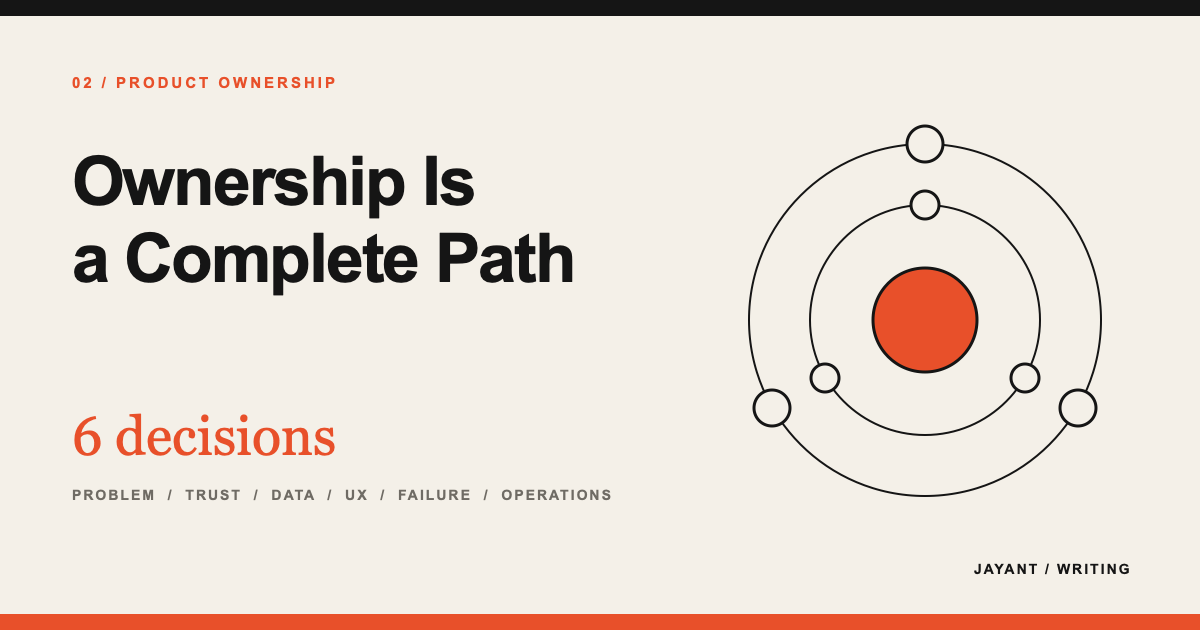
“I built the feature” and “I owned the product outcome” can describe the same week of work, but they are not the same responsibility.
The difference is what happens outside the happy path. Ownership starts before the interface and continues after deployment. It asks whether the problem is worth solving, whether the trust model is sound, whether failure is recoverable, and whether the result can be operated without its author standing beside it.
Building my own product suite made that difference impossible to ignore.
Ownership is a complete path
I use six questions to keep a feature from becoming an isolated implementation.
This is not a process diagram that every task must follow mechanically. It is a reminder that a polished UI can still hide a weak product path.
1. Own the problem, not the requested shape
The first version of a request often arrives as a solution: add a page, create a table, expose a setting. I try to restate it as an outcome before deciding the shape.
When I wanted to publish better case studies, the surface request was “add an editor.” The real problem was larger: public content had to be editable without code changes, drafts could not leak, the public page and Admin had to agree on fields, and diagrams had to render the same way during editing and after publication.
That framing led to a two-application CMS path with one database record, shared contracts, explicit publication states, and a preview that understands the same Markdown features as the public renderer. The editor was one piece of the outcome, not the product by itself.
2. Make authority explicit
Authentication answers who someone is. Authorization answers what they may do.
Admin does not receive permission merely because a session exists. Its server routes resolve the user, verify product membership and operation-specific capabilities, allowlist the target table and fields, and only then perform a privileged write. Portfolio reads public content through row-level security and never needs a service-role key.
That boundary creates more code than a direct browser write. It also makes the answer to “who can change public content?” inspectable in the route, the capability model, and the database policy.
3. Put invariants where they survive the interface
An interface can guide a user, but it cannot be the final authority for data correctness.
The database owns invariants that must remain true regardless of which client performs the operation: unique slugs, required published content, ownership filters, valid publication timestamps, and row-level access. Shared TypeScript contracts keep Portfolio and Admin aligned on the shape of the same record.
The principle is simple: validate early for a useful experience, then enforce again at the durable boundary.
4. Measure the wait the user actually feels
Page performance did not explain why authenticated Studio interactions felt hesitant. The slow unit was the full action: click, protected request, authentication, database mutation, response, and visible confirmation.
Tracing that path exposed duplicate authentication, serial reads, read-before-write patterns, and interface state that waited for every network round trip. The fix crossed proxy, API, PostgreSQL, and React state. Key write interactions improved by as much as 53 percent, and reversible actions began responding optimistically.
Likewise, bundle work became useful only when I separated whole emitted JavaScript from the chunks a route downloads initially. That distinction let me defer optional costs without removing the feature that needed them.
Ownership means choosing a metric that describes the user’s experience—not the easiest number to produce.
5. Design the failure path before calling it finished
Success states are usually straightforward. Product trust is earned in the less convenient cases.
For an optimistic mutation, the interface keeps the previous value and restores it if persistence fails. For authentication, safe-return validation prevents an external URL from becoming a redirect destination. For content publication, a hidden or draft record remains unreadable through the public query even if someone guesses its slug.
The question is not whether failure can be eliminated. It is whether the system fails in a way that preserves authority, explains the next step, and avoids creating a second hidden problem.
6. Leave an operational path
A feature that requires a code edit for ordinary operation is still partly unfinished.
That is why Admin exists as its own product surface. Content, users, access, and deployment operations have a place with stronger authorization than the public site or Studio. It is also why the monorepo has architecture checks, service-role checks, schema snapshots, route contracts, bundle budgets, and deployment-specific environment ownership.
The goal is not process for its own sake. The goal is to make a future change safer than the first one.
What changed in the way I work
Earlier in my career, I judged progress by the implementation in front of me: endpoint complete, component connected, ticket closed. I still care about those details, but I now place them inside a wider definition of done.
| Earlier question | Ownership question |
|---|---|
| Does the screen work? | Can the person complete the outcome? |
| Is the request authenticated? | Is this operation authorized? |
| Did the query succeed? | Does the data model keep its promises? |
| Is the page fast? | Which interaction does the person wait for? |
| Did it deploy? | Can it be observed, edited, and changed safely? |
Product ownership is not a job title I use to claim every discipline. It is a way of carrying the problem across boundaries, asking for another perspective when it is needed, and refusing to treat an unresolved edge as somebody else’s concern.
That is the standard I use for the work shown here: understand the problem, choose the boundary, build the complete path, verify the result, and leave the system easier to evolve.
See the four-product architecture or open the CMS case study.